CRM systems
Customer records, sales workflows, follow-up, permissions, reporting, and integrations shaped around your process.
Learn more Connect on WhatsApp
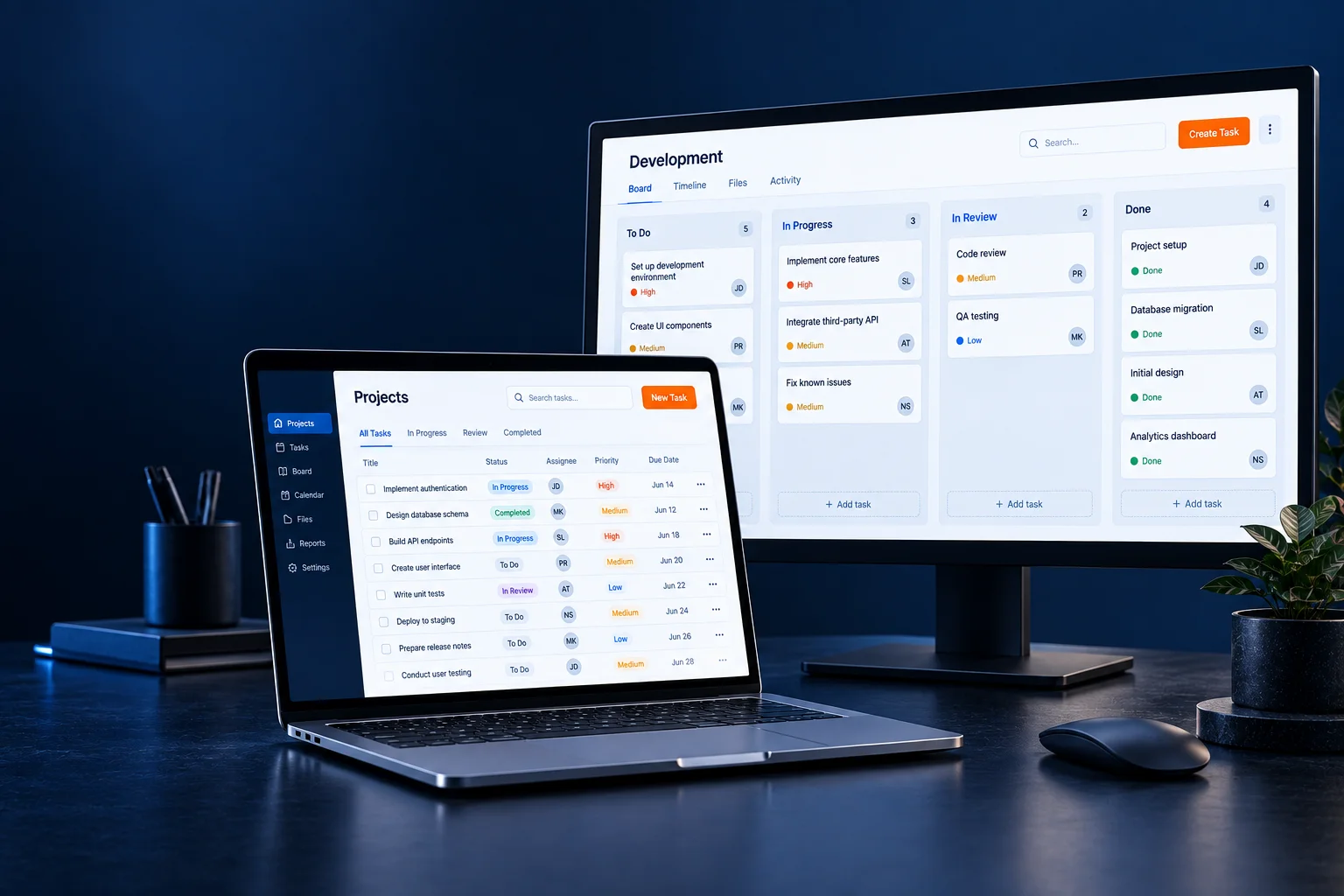
 Custom software development for business platforms, customer portals and integrations that help your team work better.
WHAT WE COVER
Customer records, sales workflows, follow-up, permissions, reporting, and integrations shaped around your process.
Learn moreSecure self-service areas for documents, requests, bookings, account information, status updates, and communication.
Learn moreInternal tools for teams, approvals, resources, task visibility, and role-based access to business information.
Learn moreAvailability, schedules, requests, confirmations, reminders, payments, and operational workflows in one experience.
Learn moreDecision-ready views for operations, sales, support, inventory, performance, and exceptions that need action.
Learn moreProduct, stock, order, supplier, warehouse, and fulfilment data connected to the workflows that use it.
Learn moreReduce repetitive work with rules, notifications, approvals, scheduled jobs, and integrations between existing systems.
Learn moreDocumented APIs and reliable connections for CRM, ERP, payments, identity, analytics, and partner platforms.
Learn moreOUR APPROACH
A custom web application is useful when a business-critical workflow cannot be handled reliably by disconnected spreadsheets or generic tools. We map the current process, define roles and data, and build the smallest dependable system that improves the outcome.
Portals and dashboards should help people take action, not only display information. We connect useful views with permissions, statuses, assignments, notes, approvals, and links to the underlying records.
Automation can reduce repeated entry, missed handoffs, and slow approvals. We design clear rules and failure handling, then connect APIs, payments, identity, CRM, ERP, analytics, and other services where they improve the workflow.
We consider authentication, roles, data boundaries, audit history, backups, monitoring, deployments, documentation, and ownership from the beginning. This keeps custom software easier to support as the organization changes.
Cost depends on the number of user roles, workflows, screens, integrations, data complexity, security needs, reporting, automation, testing, and ongoing support. A focused first release gives better evidence and a more dependable estimate than a broad feature list.
Discovery maps the current operation and desired outcome. Design makes the workflow testable. Engineering builds the application and integrations. Testing, security checks, deployment, monitoring, and documentation prepare the system for real ownership after launch.
FREQUENTLY ASKED QUESTIONS
Custom software is worth considering when manual work, disconnected systems, limited permissions, repeated errors, or generic tools prevent an important business process from working well.
We build CRM systems, customer and employee portals, booking systems, admin dashboards, inventory tools, workflow automation, API integrations, and other browser-based business applications.
Cost depends on workflows, roles, data, integrations, security, reporting, automation, testing, and support. Nixoware recommends a phased scope so the first release can prove value before broader investment.
Yes. We can plan and develop connections to CRM, ERP, payment, identity, analytics, inventory, cloud, and partner systems through documented APIs or other appropriate integration methods.
Yes. Support can include monitoring, security updates, bug fixes, infrastructure work, documentation, user feedback, and a prioritized roadmap for new capabilities.